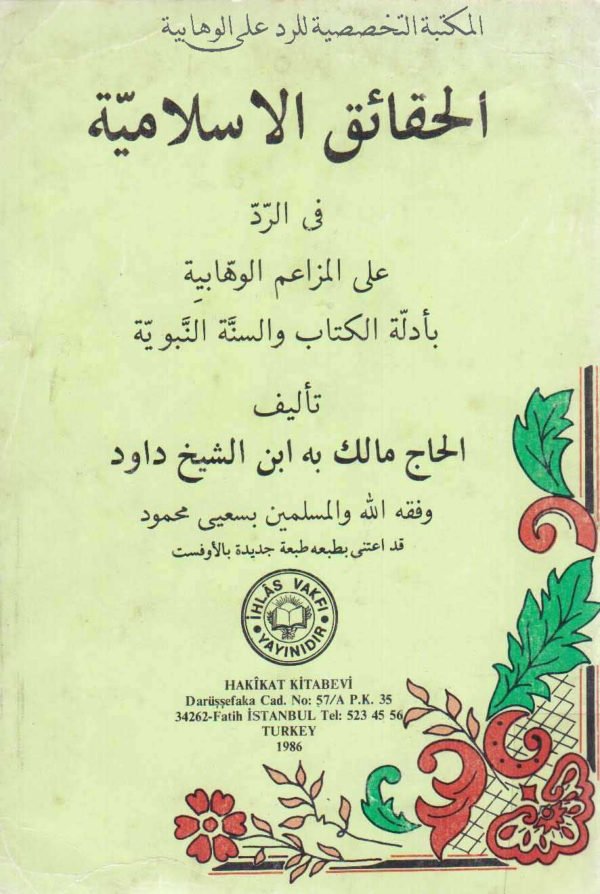
Ibn ʿAfaliq al-Ahsaʾi and "Tahakkum al-muqallidin": Putting the Claim of Renewal to the Test
A letter from a Hanbali jurist of al-Ahsa to his contemporary Muhammad ibn ʿAbd al-Wahhab, testing the claim to ijtihad with questions on hadith, Arabic, rhetoric and inheritance law.
The author and the context of the epistle
Muhammad ibn ʿAbd al-Rahman ibn ʿAfaliq al-Hanbali al-Ahsaʾi (1100–1164 AH) was a Hanbali jurist of al-Ahsa, a contemporary of Muhammad ibn ʿAbd al-Wahhab with whom he corresponded. His epistle, known as "Tahakkum al-muqallidin fi muddaʿi tajdid al-din" (The Irony of the Imitators toward the Claimant to Renewal of Religion), takes the form of a direct letter opening with: "From Muhammad ibn ʿAbd al-Rahman to Muhammad ibn ʿAbd al-Wahhab." The author then states that he has seen the principles of his addressee's call, written in his own hand:
I have come across the rules upon which you built your doctrine; they reached me in your own handwriting[1]
Ibn ʿAfaliq holds that these rules entail judging much of the legal opinion recorded in the schools as speech without knowledge, which in turn amounts to impugning the imams and those who follow them. Yet he does not begin by discussing these rules one by one. Instead, he first puts their author to a test of his qualification to claim ijtihad and renewal, promising a detailed refutation afterwards.
Imitation as a chain of transmission
The author starts from the image of the scholar in Islamic tradition as drawn by the biographical dictionaries: a man who says "I read with so-and-so, I heard from so-and-so, I studied law under so-and-so." He cites the examples of Ibn ʿAqil, the judge Abu Yaʿla, al-Sharif Abu Jaʿfar and Ibn al-Manni, as well as Ibn Kathir, author of the Qurʾan commentary that was read out to the public, to show that these scholars, for all their eminence, remained attached to their teachers and acknowledged the merit of those before them. He then states:
And none of them called people to follow him, nor compelled them to adopt his way and conduct.[2]
He contrasts this with one who claims direct derivation without a chain of transmission or known teachers, noting that this person nonetheless relies, for Qurʾanic exegesis, on the books of those very "imitators." Hence the paradox of the title: the author speaks in the name of the "imitators" and holds that, while acknowledging their taqlid, they meet the conditions of knowledge better than the one who claims renewal.
The examination questions
The core of the epistle is a series of questions arranged in chapters: questions on hadith, questions on the Qurʾan, questions of inheritance, and then ijtihad and taqlid. Their aim is to show the scope of the sciences required of anyone who wishes to derive rulings directly from the texts.
In hadith science
The author demands that one distinguish, within the two Sahihs and the four Sunan, the mutawatir, mustafid, ʿaziz and gharib reports, set out the grades of sahih and hasan, the corroborating and supporting narrations, and then establish the status of the narrators of each hadith:
For every hadith I have asked you about, set down for me the names of its narrators, their kunyas, their places and their times[3]
His argument is that issuing fatwas on the basis of hadith is lawful only for one who knows its routes, narrators and hidden defects, and that whoever wants to give rulings directly from the hadith collections takes on a burden not borne by the jurists who issue opinions from the recorded works of their school.
In Arabic, rhetoric and exegesis
He then takes Surat al-ʿAdiyat, one of the short suras of the mufassal, as a testing ground, asking about the legal, lexical and customary literal meanings, the kinds of figurative speech, metaphor and simile, concision and amplification, disjunction and conjunction, and the aspects of inimitability it contains. He makes clear that he asks for nothing beyond what the works of this discipline have established:
I ask you only about what Ibn al-Qayyim and others have explicitly stated, and I require of you only to extract this from the books written on it; whereas the one who derives is he who has a firmly rooted faculty within himself by which he grasps all of that[4]
For him, the one who derives is someone in whom the sciences of Arabic are a living faculty, not information looked up in books when needed.
In inheritance law
On the questions of the grandfather and the brothers, proportional reduction (ʿawl), and the two cases known as the ʿumariyyatan, the author raises a methodological difficulty: if there is a clear text without contradiction, why did the Companions disagree? And if there is none, then the Companions and those after them exercised ijtihad where no explicit text existed, which, in the author's view, his addressee's rule ends up condemning.
Ijtihad and taqlid
In the final chapter he asks about one who reaches puberty in sound mind and wishes to practise the upright religion: should he be ordered to exercise ijtihad from the outset, even though he knows neither the verses, nor the traditions, nor legal theory, nor Arabic? Or should he be ordered first to learn
what pertains to ijtihad until he becomes qualified; but before he has learned and become qualified, what is he to do?[5]
He argues that the only practical answer is to turn to the scholars and what they recorded in the four schools, and that rejecting this path forces ordinary people, including the new convert, to imitate the author of the call alone.
Tone and purpose of the epistle
The epistle is not free of sharp expressions, in keeping with the conventions of polemics in its time, as the title itself indicates. Yet in its conclusion the author declares his purpose:
I did not intend by this debate obstinacy, nor insult and quarrel, nor blameworthy dispute, but rather seeking the Face of God, the Living, the Self-Subsisting[6]
Conclusion
Ibn ʿAfaliq's epistle is an early testimony from within the Hanbali school, and from the very milieu of al-Ahsa and Najd, showing that the disagreement was not at root between Hanbalis and others, but concerned the conditions of ijtihad and the standing of the recorded juristic heritage. Its scholarly value lies in its method: it turns the claim of renewal into a testable question: what tools does one possess who claims to derive rulings directly from the Qurʾan and the Sunna?
Sources & references
فقد وقفت على القواعد التي بنيت عليها مذهبك ،ووصلت إلي بخط يدك
ولا أحد منهم دعا الناس إلى اتباعه ،ولا حملهم على هديه وسيرته.
وكل حديث مما سألتك عنه ،حرر لي أسماء رواته ،وكناهم ،وأمكنتهم ،وأزمنتهم
فلا أسألك إلا عما نص عليه ابن القيم ،وغيره ،ولا أكلفك إلا استخراج هذا من الكتب المصنفة فيه ،مع أن المستنبط هو الذي له ملكة راسخة في نفسه يدرك بها جميع ذلك
ما يتعلق بالاجتهاد حتى يتأهل ،فقبل تعلمه ،وتأهله ،ماذا يفعل؟
ولم أقصد بالمناظرة المكابرة ،ولا السباب والمناقرة ،ولا الجدال المذموم ،بل ابتغاء وجه الله الحي القيوم